At VivaTech 2026, Eric Salobir, President of the Human Technology Foundation, took part in several panel discussions addressing the major challenges arising from ongoing technological transformations. Employment, artificial intelligence, inclusion, and digital sovereignty were at the center of these conversations, at a time when advances in AI are already reshaping socio-economic and geopolitical dynamics.
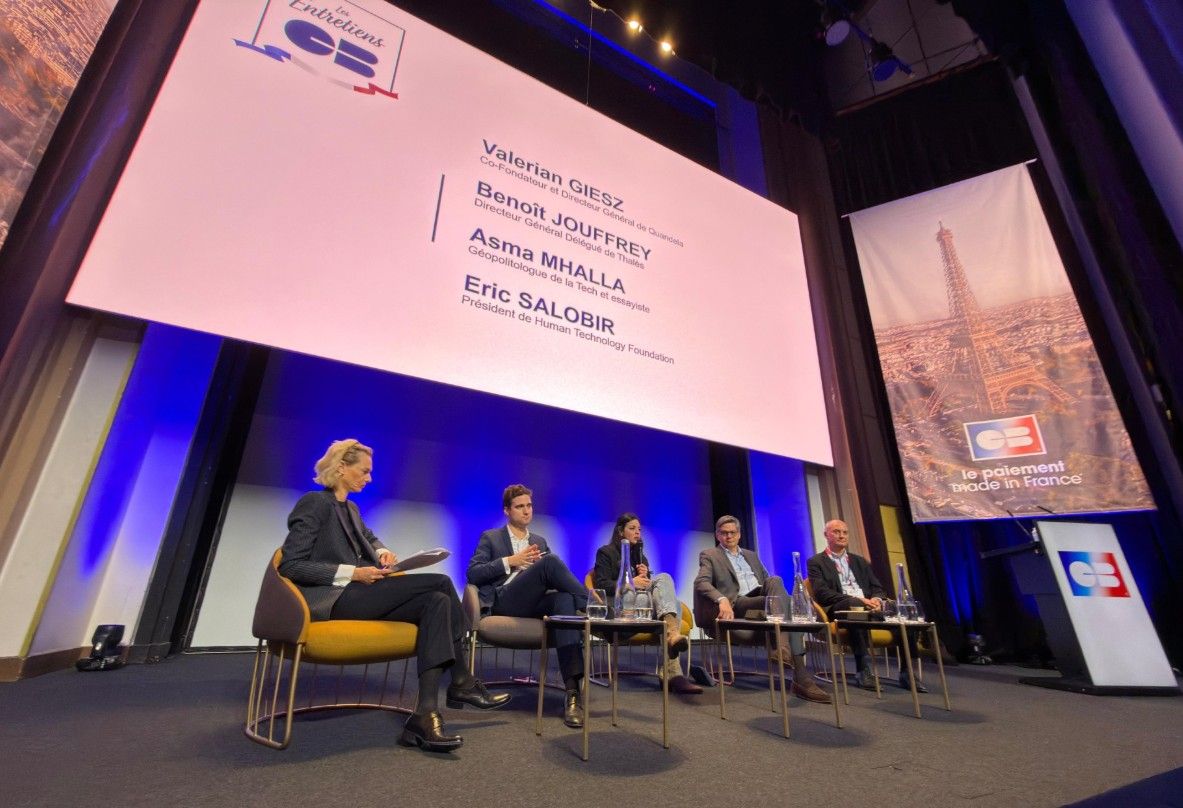
Invited by the Caisse des Dépôts, Eric Salobir joined Pierre Aubouin, Executive Director of Caisse des Dépôts, for a panel discussion focused on a question that has become increasingly critical: how can we reconcile the development of artificial intelligence with responsibility and the preservation of employment?
Key takeaways from the discussion included:
While these technologies are often discussed together, their implications for work and employment differ significantly.
Today, generative AI mainly enables professionals who use it effectively to save time and enhance performance. At this stage, its direct impact on employment remains relatively limited.
By automating entire processes, agentic AI has the potential to fundamentally transform the organization of work and significantly affect certain job categories.
This evolution raises important questions about access to the labor market for young people, especially in sectors where entry-level positions may be substantially reduced through automation.

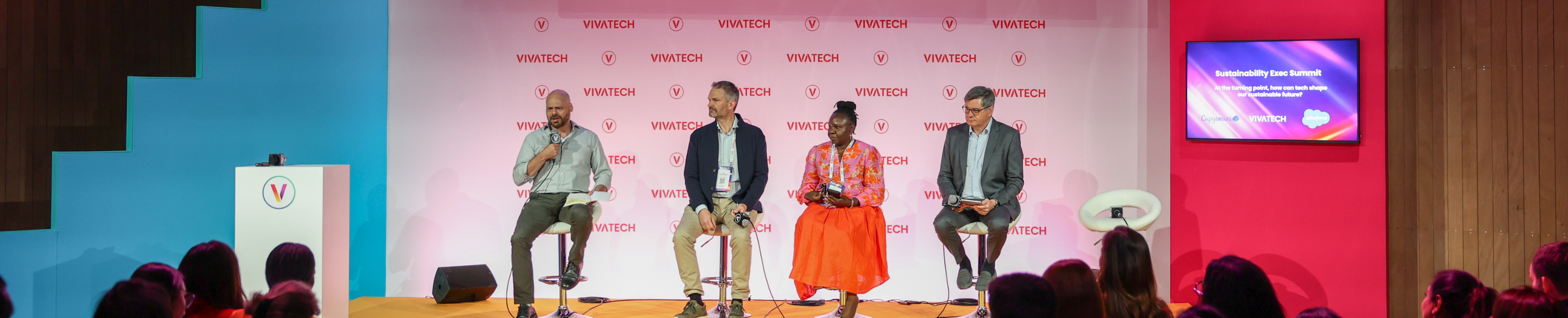
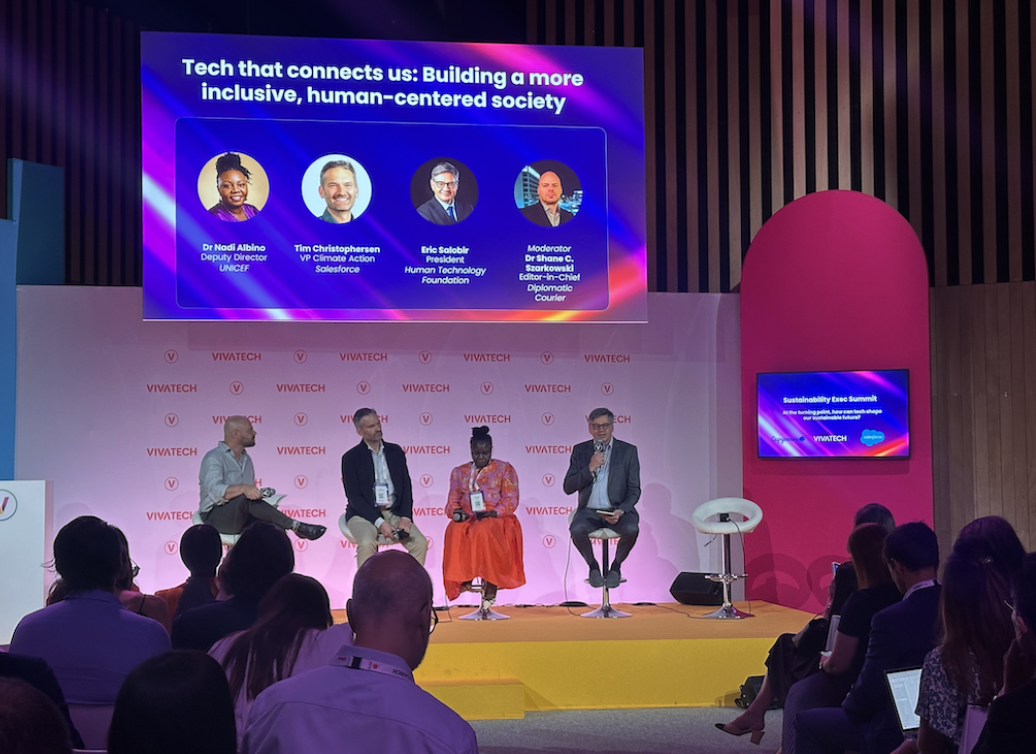
The following day, at Salesforce’s invitation, Eric Salobir participated in the panel discussion “Tech That Connects Us: Building a More Inclusive, Human-Centered Society” alongside Dr. Nadi Albino (UNICEF) and Tim Christophersen (Salesforce).
The discussion focused on the conditions required to ensure that technological development remains genuinely inclusive. As innovation advances at an unprecedented pace, the central question is no longer simply what technology makes possible, but rather the kind of society in which we choose to embed it.
This perspective reflects one of the Human Technology Foundation’s core convictions: technological progress must remain in service of human development.
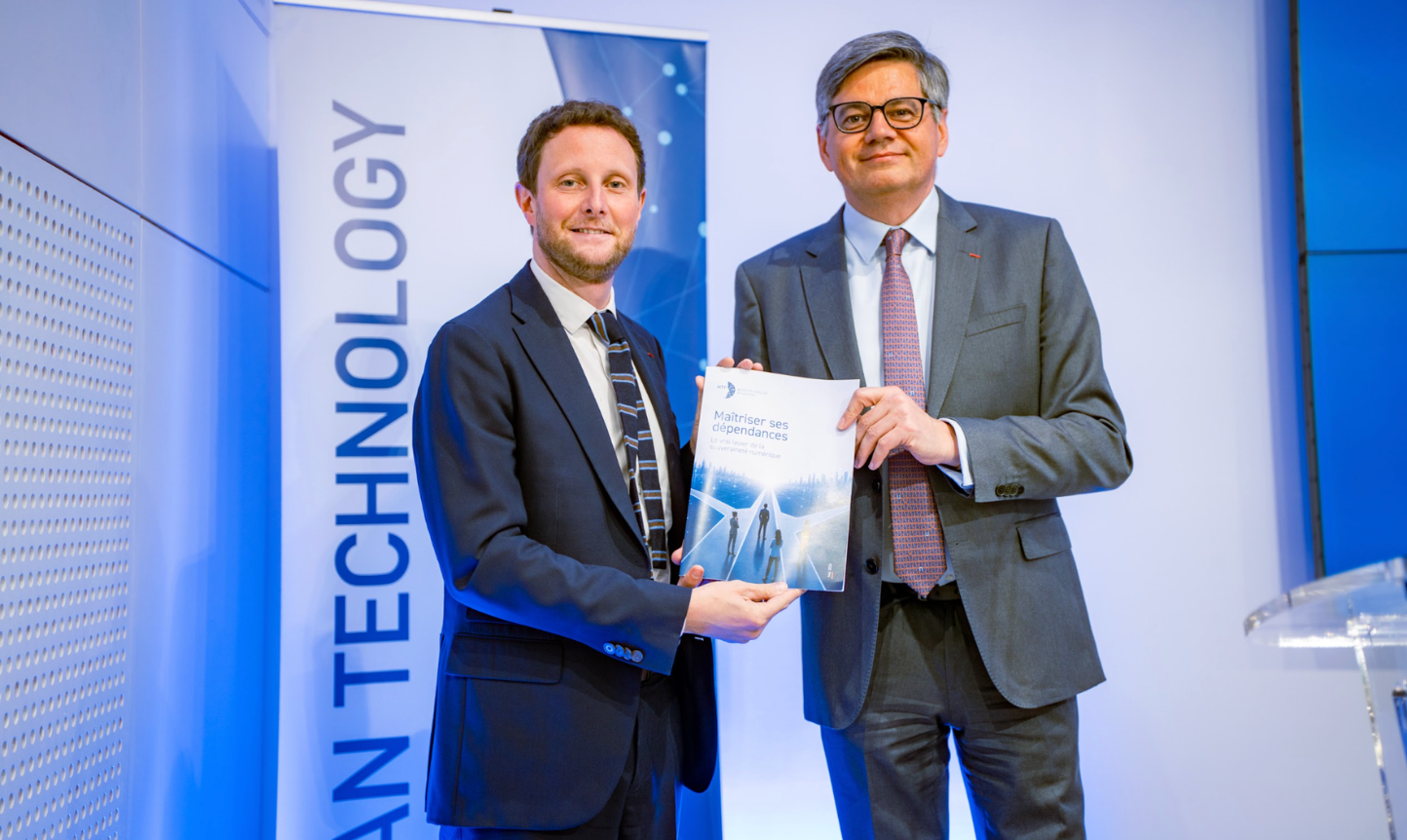
These discussions also echoed the Foundation’s recent work on digital sovereignty, presented at VivaTech through its report Mastering Dependencies: The Real Lever of Digital Sovereignty.
At a time when artificial intelligence, cloud computing, and digital infrastructures have become essential components of our economies, digital sovereignty can no longer be viewed solely as a technological issue. It raises fundamental questions related to democratic governance, strategic autonomy, economic resilience, environmental responsibility, and citizen education.
For the Human Technology Foundation, the challenge lies in developing the capacity to choose our dependencies and create the conditions for informed autonomy.

One of the highlights of this year’s VivaTech was Eric Salobir’s announcement, from the Main Stage, of the launch of the “Agentic AI and Work” Coalition, an initiative led by the Human Technology Foundation.
The coalition is founded on a simple observation: agentic AI will not merely improve organizational productivity. By automating entire processes and taking over tasks previously performed by human teams, it is set to profoundly transform working methods, organizational structures, and career paths.
This transition represents a major social challenge that must be anticipated and actively managed.
The ambition of the “Agentic AI and Work” Coalition is therefore to bring together companies, experts, and transformation leaders to better understand the impact of these technologies; identify the jobs and skills that will be needed tomorrow; design the training and reskilling programs required; and foster cooperation among organizations to create new professional opportunities for employees affected by these changes.
Officially unveiled at VivaTech, the coalition already brings together more than 25 member companies of the Human Technology Foundation. It is intended to become a platform for dialogue, experimentation, and collective action to help prepare the future of work in the age of agentic AI.

The discussions that shaped this year’s VivaTech highlight an increasingly evident reality: the challenges associated with artificial intelligence extend far beyond technological innovation.
They affect employment, education, social cohesion, economic competitiveness, and democratic sovereignty. In response to these challenges, the Human Technology Foundation continues its work in research, dialogue, and stakeholder engagement to contribute to a model of technology governance that places people at the center of collective decision-making.
Because the future of AI will not be determined solely by what technology is capable of achieving, but by the choices we make about how it is used.